
A dental implant is a surgical component placed into the jawbone, designed to support a dental prosthesis like a crown, bridge, or denture. It acts as a replacement for the root of a missing tooth. The implant itself is typically made of titanium, which is biocompatible, meaning it’s well-accepted by the body.
Here’s an overview of the dental implant process:
Consultation & Planning
- The dentist will assess your oral health, including the condition of your gums and jawbone. They may use X-rays or 3D imaging to evaluate how the implant will fit and where it should be placed.
- Your dentist will also review your medical history to make sure you’re a good candidate for the procedure.
Implant Placement Surgery
- The implant is surgically placed into your jawbone. This is usually done under local anesthesia, although sedation may be an option depending on the complexity of the procedure.
- The implant needs time to fuse with the bone in a process called osseointegration, which can take a few months.
Healing Period
- During this phase, the bone and implant will integrate, becoming a solid foundation for the future restoration.
- You’ll have follow-up visits to ensure everything is healing properly.
Abutment Placement
- Once the implant is securely fused with the bone, an abutment (a connector piece) is attached to the implant. This holds the crown or other restoration in place.
Restoration
- Finally, a custom-made crown, bridge, or denture is attached to the abutment, completing the implant.
Benefits of Dental Implants:
- Natural Look and Feel: Implants are designed to mimic the look, feel, and function of natural teeth.
- Durability: Implants are long-lasting and, with proper care, can last a lifetime.
- Bone Preservation: Since the implant is placed directly into the jawbone, it can help preserve bone structure.
- Improved Function: Implants restore full chewing power, allowing you to eat your favorite foods without worrying about dentures slipping.
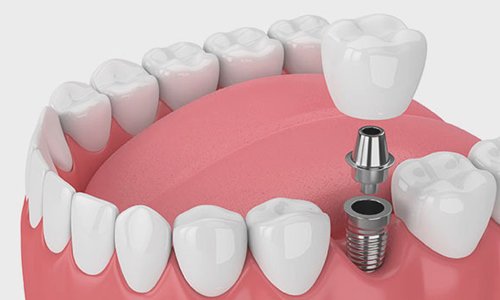
Single-Tooth Implants
Ideal for : Individuals who need to replace one missing tooth.
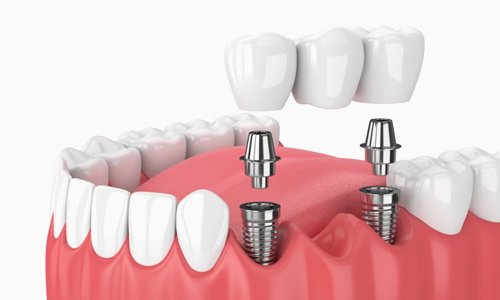
Implant-Supported Bridges
Ideal for : People who need to replace multiple teeth in a row.
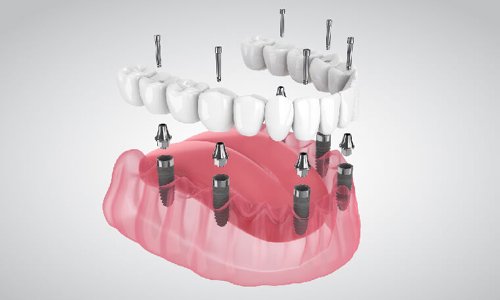
All-on-4 / All-on-6 Implants
Ideal for : People who need a full set of teeth replaced (all upper or lower teeth).
Dental implants come in several types, each suited for different needs and conditions. The main types of dental implants are:
Endosteal Implants
- Description: These are the most common type of dental implant. They are placed directly into the jawbone and typically made of titanium.
- Structure: They look like small screws, blades, or cylinders.
- Ideal for: Patients with healthy bone structure who are looking to replace a single tooth or multiple teeth.
- Procedure: The implant is surgically placed into the jawbone. After healing and osseointegration (bone fusion), the abutment and crown are attached.
Subperiosteal Implants
- Description: These implants are placed on top of the jawbone but beneath the gum tissue. They don’t go into the bone itself, which makes them a good option for patients who have insufficient bone height or quality.
- Structure: They have a metal frame that sits on the jawbone, with posts that protrude through the gum to hold the prosthetic teeth.
- Ideal for: Patients with bone loss or inadequate jawbone height that cannot support traditional endosteal implants.
- Procedure: The metal frame is placed underneath the gum, and over time, the gum tissue heals around it. The abutment is then attached to the frame.
Zygomatic Implants
- Description: These are the least common type of dental implant and are used when there’s severe bone loss in the upper jaw.
- Structure: The implants are anchored into the cheekbone (zygomatic bone) rather than the jawbone.
- Ideal for: Patients who don’t have enough bone in the upper jaw to support traditional implants and who are not candidates for bone grafting.
- Procedure: These implants are longer than regular implants and are placed into the zygomatic bone. This type of implant requires a more complex procedure and may involve greater healing time.
Other Categories Based on Prosthetic Design:
Single-Tooth Implants
- Description: A single titanium implant is placed to replace a missing tooth. It’s followed by a custom-made crown that fits seamlessly with the surrounding teeth.
- Ideal for: Individuals who need to replace one missing tooth.
- Procedure: After the implant is placed, the healing process takes place, followed by the placement of a crown.
Implant-Supported Bridges
- Description: When several adjacent teeth are missing, an implant-supported bridge may be used. It requires two or more implants to support a bridge of artificial teeth.
- Ideal for: People who need to replace multiple teeth in a row.
- Procedure: Implants are placed at strategic points, and a custom bridge is attached.
All-on-4 / All-on-6 Implants
- Description: This is a full-arch restoration technique where a full set of teeth is supported by only four or six implants in the upper or lower jaw.
- Ideal for: People who need a full set of teeth replaced (all upper or lower teeth).
- Procedure: Four or six implants are strategically placed to support a fixed prosthetic dental bridge. This is especially useful for people who have lost most or all of their teeth and do not want traditional dentures.
- Advantage: It’s a faster and less invasive alternative to placing an implant for each missing tooth.
Mini Implants
- Description: Mini implants are smaller in diameter than standard implants, typically used when there’s insufficient bone for a traditional implant or when cost is a concern.
- Structure: They resemble a pin or screw and are often used for securing dentures or bridges.
- Ideal for: People with smaller or less dense bone, or those who need a less invasive option.
- Procedure: Mini implants can sometimes be placed without the need for bone grafting, making them a quicker and less costly option.
Choosing the Right Type:
The choice of implant depends on:
- Bone Density: Stronger bones are suited for endosteal implants, while weaker or thinner bones might require subperiosteal or zygomatic implants.
- Number of Teeth Missing: Single implants work for one tooth, whereas implant-supported bridges or full-arch implants are used for replacing multiple teeth.
- Jaw Health: Patients with significant jawbone loss may need mini implants or zygomatic implants.
- Aesthetic Concerns: For a natural look and feel, all implant types are designed to blend with surrounding teeth, but the method of placement might differ.
Would you like to know more about any specific type, or are you considering implants yourself